Why the Calendar Invite Was Always the Missing Last Step in Group Chat Scheduling
Group plans stall without an invite, so scheduling needs one.
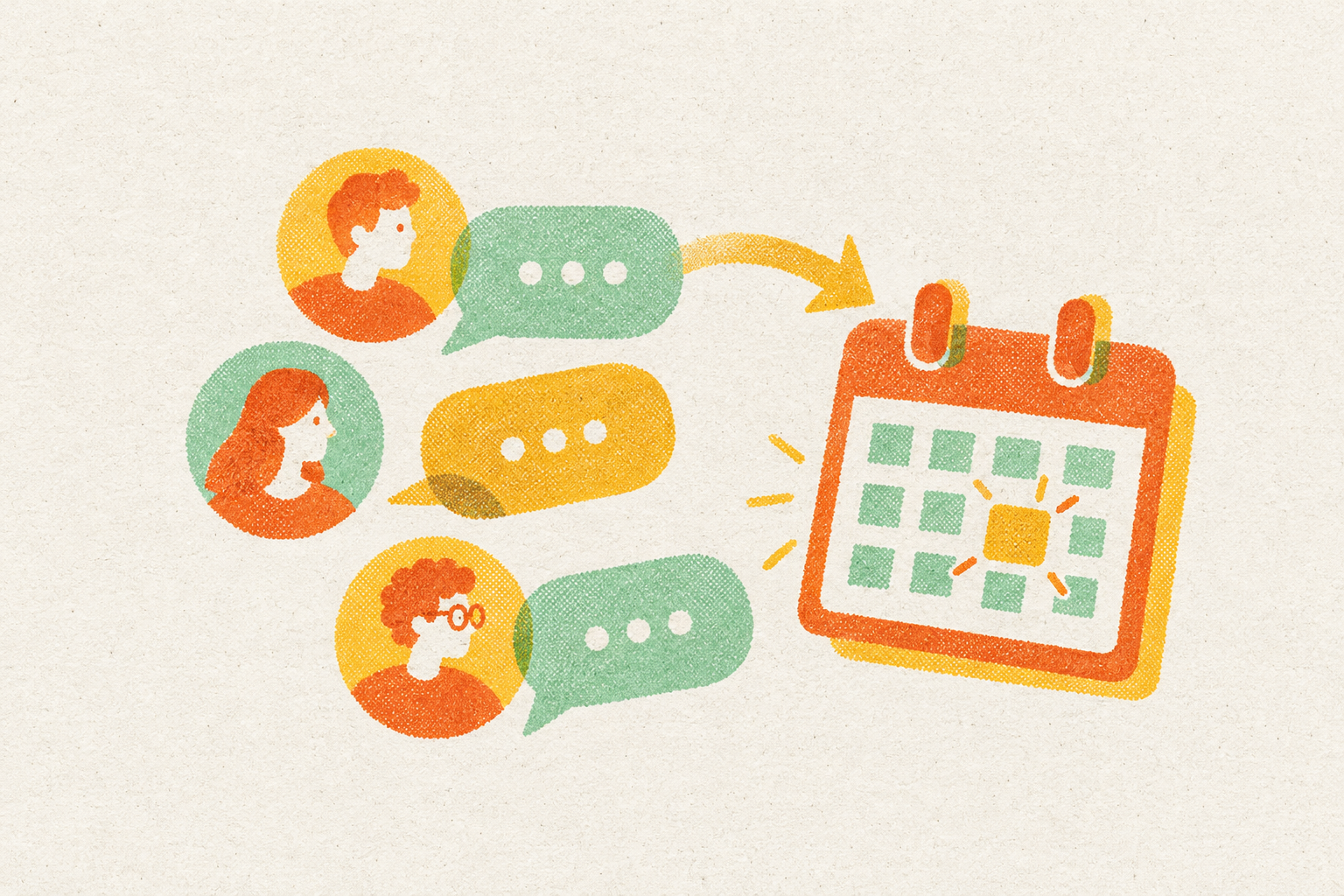
An AI scheduling assistant inside iMessage group chats can help people go from agreeing to meet to putting the event on the calendar. Pencil is designed to handle the follow-up, send the invite, and then step back. The calendar invite is the commitment mechanism that group scheduling needs inside the conversation.
Why group chats are built for enthusiasm, not decisions
A heart emoji, “omg yes,” or “+1” expresses interest without requiring anyone to choose a date or take responsibility for the next step. Those responses serve the conversation well. They establish that people want to meet, but the medium does not distinguish that shared desire from a settled arrangement. The mismatch is architectural.
An open-ended question such as “when is everyone free?” exposes that mismatch because each participant can reasonably wait for more information from the others. There is no clear point at which expressing interest becomes accepting a specific commitment. The thread can be alive Tuesday, quiet by Thursday, and scrolled off the screen the following week. No one has rejected the original suggestion. Yet nothing in the exchange has produced an object that persists beyond the scroll.
The four mechanics that turn a live thread into a dead plan
Diffusion of responsibility leaves the next action unclaimed. The more people who see the message, the easier it becomes for each person to assume someone else will respond first or take charge. A suggestion can therefore reach the whole group without giving any participant a clear reason to move it forward.
A conversational “yes” has none of the formality of an RSVP to a defined event, so interest remains easy to withdraw from or forget. Meanwhile, too many open variables prevent that event from taking shape. Dates, venues, times, and logistics compete for attention, with an unresolved choice blocking the others. Sequencing the decisions, with the date settled before the group begins choosing a venue, gives the discussion a narrower task.
Even resolving those problems leaves the two-step trap. The group can agree on a time and still depend on someone to create and send the calendar invite afterward. During that interval, someone may double-book the slot because the agreement has not reached their calendar. Solving just one of these problems, who takes charge, how people commit, or what to decide first, leaves other ways for the plan to stall.
The social cost of being the one who keeps pushing
Following up is not simply another administrative task. It draws attention to how someone’s stated enthusiasm can exceed their willingness to commit. The sender asks for an answer while also revealing how much they want the gathering to happen. That exposure makes a straightforward availability request feel socially consequential, especially when everyone else has gone quiet.
For the person who most wants the plan to happen, being keen can feel like enough, so taking the next step seems less urgent than it is. Once the conversation stalls, though, that same person has the most reason to get it going again and runs the greatest risk of seeming to care more than everyone else. Agreement has already supplied the feeling of progress. Asking for a firm answer can then feel like reopening something that the group appeared to settle.
This is a collective action problem with a personal penalty attached to solving it. The organizer has to do the work for the group while watching how that work makes them look. Being that person again and again can wear them out even when people are glad to be invited. The missing ingredient is a way to remove the social exposure from the specific act of nudging.
Why the calendar invite is not a formality — it is the moment a plan becomes real
A calendar invite gives the agreement a durable form. It specifies the date, time, location, and relevant logistics in an object that remains available on the day of the event. With the invite, people can check the plan without having to remember where the chat left off or find the right message in a thread that keeps moving. The plan now has a stable reference point. That changes what participants are being asked to accept.
The invite also connects the agreement to calendar reminders and RSVPs. These provide the machinery for remembering the event and distinguishing an invitation from an accepted commitment. A time and place become something participants can respond to explicitly.
This does not mean an invite guarantees attendance. Its significance is that it establishes the event against which attendance, conflicts, and reminders can be understood. Before that object exists, even an agreed time remains vulnerable to the gap between conversational memory and the calendar used to manage the day. Sending the invite is therefore part of making the decision operational.
Why iMessage has no native path from agreed time to calendar event
The missing step is especially clear in an iMessage group conversation. Reaching agreement does not itself assemble the time, place, and participants into a calendar event and send it to the group. An organizer still has to do that work as a separate task. The handoff arrives just as the discussion has finally converged, requiring someone to leave the thread and reconstruct its outcome in Calendar.
A booking link or a request to download another app asks participants to leave the conversation and complete an action elsewhere before coordination can continue. That can be a lot to ask when the plan is already losing steam. The tool may make some scheduling work easier while adding another step where people stop taking part.
Sharing one person’s open slots is also different from getting several people to agree. A booking link addresses the former. A group hangout requires the latter, followed by a shared event that records the result. In iMessage, the structural gap is not a lack of willingness to discuss a plan, but the absence of a native path that completes that sequence.
What a well-timed nudge does that a person cannot
An automated follow-up changes who bears the social exposure of asking for an answer. When the group has agreed to an assistant’s presence, the request can serve the scheduling task without implying that one friend is more impatient or invested than another. The people retain ownership of the invitation. The assistant handles the narrower job of moving an unanswered question toward a decision.
Specificity is central to that role. Asking when everyone is free leaves people to work out which times to discuss, while suggesting a slot gives them a clear choice. A prompt about when, where, or how turns general enthusiasm into something the group can answer. Automation is useful here not merely because it sends another message, but because it can make the next response easier to give.
The intervention still needs timing and restraint to help. An assistant that everyone has agreed to use has a different standing from a tool introduced without the group’s understanding. Its follow-up should support the conversation. Removing the awkwardness from this one act leaves the organizer free to remain warm and personal in the parts of the exchange that brought people together.
How can a group hangout be scheduled without leaving iMessage?
In-chat scheduling keeps the proposal, availability check, follow-up, and calendar invite in the conversation where the plan begins. Someone suggests meeting, and an assistant suggests times when people are free. Participants answer in the same thread rather than moving to a booking page or a separate app. The next step stays where the attention already is. That continuity is what removes the manual handoff from the workflow.
The assistant then follows up with people who have not replied. Once consensus forms, it sends the calendar invite rather than leaving its creation as an unassigned task. This is the complete sequence that an in-chat approach needs to support. Finding a possible time solves only part of the problem if someone must still translate the result into an event.
Pencil embodies this approach through its stated role of handling the follow-up, sending the invite, and stepping back. Its use-case fit is the group conversation that has enough enthusiasm to begin but lacks a dependable way to finish scheduling. The relevant criteria are concrete, including participation in the same thread, follow-up that does not expose an organizer socially, and completion with a calendar invite. Participants need availability to make that decision while the events behind it remain private.
Why privacy inside a group chat has to be a design choice, not an assumption
Adding an assistant changes who encounters the conversation. One person’s decision to introduce a tool is not the same as every participant’s informed agreement to its presence. The assistant may encounter availability and the relationship context expressed in the thread, including information from people who did not invite it. A privacy policy alone cannot resolve that distinction. The design must account for everyone in the group, including the person who initiated access.
A class action filed in August 2025 alleged that OtterPilot auto-joins meetings without consent from all participants, in a context where California law requires all-party consent before recording. That allegation concerns meeting recording. Its relevance is the architectural question of whether one participant can introduce an assistant whose activity affects others.
The European Commission’s AI Act enforcement page places the start of enforcement powers and the enforceability of certain provisions on August 2, 2026. Social scheduling tools are not the direct target described in the brief, but the underlying design question applies to them as well. An assistant’s role in a conversation needs to be deliberate, rather than treated as an incidental consequence of convenience.
For scheduling, keeping availability separate from private event details sets a clear limit on what is shared. Pencil helps people plan together without sharing those details in the group discussion. A constraint can shape the proposed times without exposing the reason for that constraint. Sharing when someone can meet is different from sharing what they are doing when they cannot.
The plan that actually happens is the one that never left the conversation
The group chat is already where the anticipation lives. It holds the suggestion, the interest, and the reason people wanted to reconnect in the first place. Moving the commitment mechanism into that same conversation reduces the distance in which those intentions can dissipate. The group does not need another person to turn a welcome invitation into an ongoing chore.
The warmth belongs to the people who made the plan. Once the event is on the calendar, the tool can recede, leaving a gathering that still feels like it came from the group. The last step has happened where the plan began, rather than waiting for someone to remember it elsewhere.